

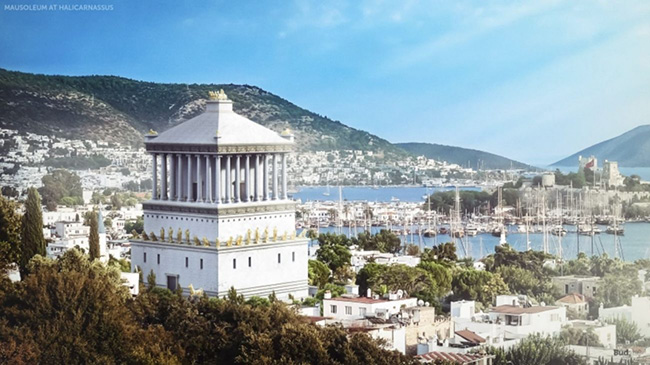
The Mausoleum at Halicarnassus: History, Architecture and Legacy
The Mausoleum at Halicarnassus was one of the Seven Wonders of the Ancient World and remains one of the most influential funerary monuments ever built. Constructed in the 4th century BCE in Halicarnassus (modern-day Bodrum, Turkey), it was the grand tomb of Mausolus, a powerful ruler of Caria, and his wife and sister Artemisia II.
So remarkable was this structure that the word “mausoleum” itself comes directly from Mausolus’s name. Although the monument no longer stands intact, its architectural legacy continues to shape monumental tomb design across civilizations.
Historical Background
Caria and Mausolus
Caria was a semi-independent region in southwestern Anatolia under the Achaemenid Persian Empire. Mausolus ruled as a satrap (governor) from 377–353 BCE, but he behaved more like an independent king.
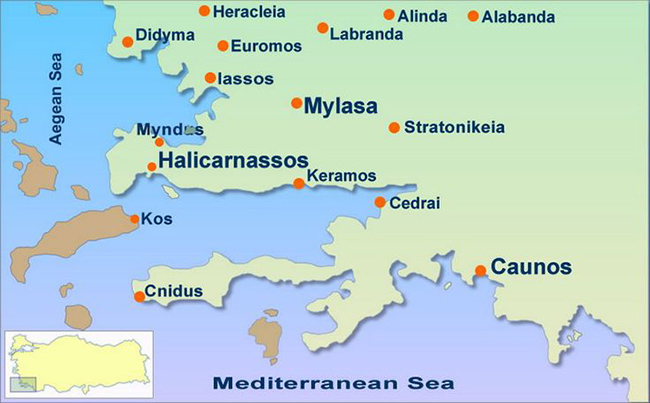
He moved the Carian capital from Mylasa to Halicarnassus, transforming it into a fortified, cosmopolitan city influenced by Greek culture. Mausolus encouraged Hellenization, adopted Greek architectural styles, and commissioned grand public works to display his power and prestige.
Commissioning of the Mausoleum
The Mausoleum was commissioned around 353 BCE, either shortly before or immediately after Mausolus’s death. His wife Artemisia II oversaw the project, determined to create a tomb that would immortalize his rule.
Ancient sources describe Artemisia as deeply devoted to Mausolus, both politically and personally. According to legend, she even mixed his ashes with liquid and drank them as an act of devotion, though this story is likely symbolic rather than historical.
Architectural Design and Structure
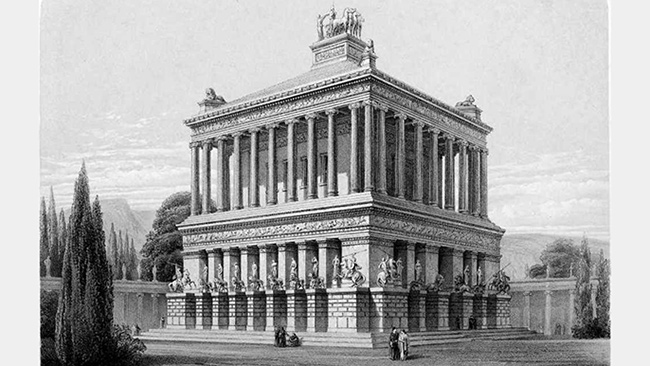
The Mausoleum stood approximately 45 meters (148 feet) tall, making it one of the tallest structures of the ancient world.
Overall Structure
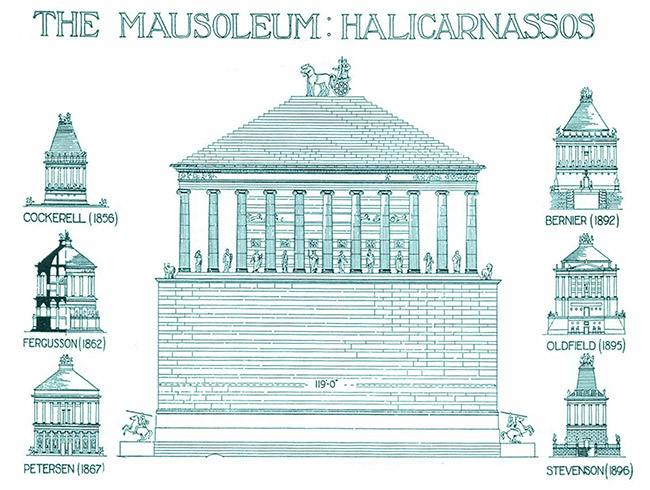
The monument consisted of three main sections:
- A massive rectangular podium
- A colonnaded middle section
- A stepped pyramidal roof topped by a sculpture
This combination of Greek, Egyptian, and Near Eastern architectural elements made the Mausoleum unique.
The Podium
- Built on a solid stone platform
- Contained the burial chamber of Mausolus
- Decorated with sculpted reliefs showing:
- Battles between Greeks and Amazons (Amazonomachy)
- Greeks versus Centaurs (Centauromachy)
- Scenes of gods and heroes
These reliefs symbolized order triumphing over chaos and reinforced Mausolus’s image as a heroic ruler.
The Colonnade
- Surrounded by 36 Ionic columns
- Created an open, temple-like appearance
- Allowed light to illuminate the sculptures inside
- Reflected classical Greek architectural ideals
Between the columns stood statues of gods, heroes, lions, and members of the royal family.
The Pyramid Roof
- Consisted of 24 stepped levels
- Inspired by Egyptian pyramid forms
- Symbolized ascent toward the heavens
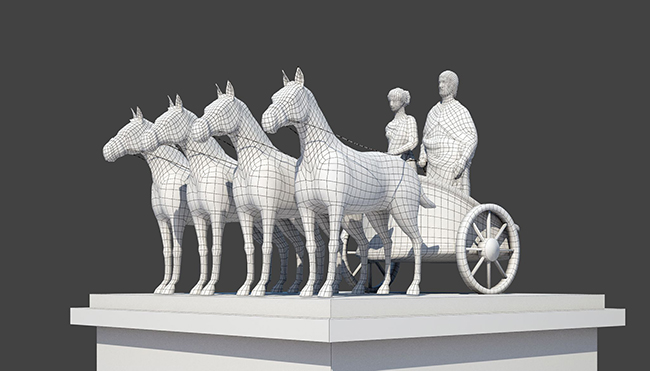
At the very top stood a monumental quadriga sculpture—a four-horse chariot—carrying statues of Mausolus and Artemisia, emphasizing their semi-divine status.
Sculptors and Artistic Excellence
The Mausoleum was adorned by some of the greatest Greek sculptors of the age:
- Scopas
- Bryaxis
- Leochares
- Timotheus
Each sculptor was responsible for one side of the monument, resulting in an extraordinary fusion of styles unified by exceptional craftsmanship. Ancient writers praised the realism, emotion, and dynamic movement of the sculptures.
Symbolism and Meaning
The Mausoleum was not merely a tomb—it was a political statement.
- It proclaimed Mausolus’s power and legitimacy
- Combined Eastern royal traditions with Greek aesthetics
- Elevated a mortal ruler to near-divine status
- Demonstrated Caria’s cultural sophistication
In essence, it was architecture as propaganda, projecting eternal authority.
Destruction and Decline
The Mausoleum survived for over 1,600 years, an impressive feat.
Causes of Destruction
- A series of earthquakes between the 12th and 15th centuries CE gradually damaged the structure
- By the time medieval travelers visited, it was partially ruined
- In the 15th century, the Knights of St. John dismantled much of the Mausoleum
- Stones were reused to build the Castle of St. Peter (Bodrum Castle)
Ironically, some sculptural fragments survived because they were embedded in the castle walls.
Archaeological Rediscovery
In the mid-19th century, British archaeologist Charles Thomas Newton conducted excavations at the site.
Discoveries Included:
- Sculptural fragments
- Relief panels
- Parts of the quadriga
- Stone lions and statues
Many of these artifacts are now housed in the British Museum, where they remain among its most celebrated ancient collections.
The Mausoleum Today
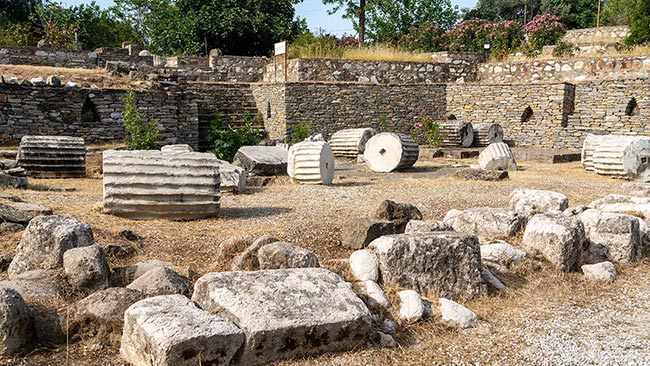
Today, the original site in Bodrum contains:
- Foundation stones
- Partial columns
- An open-air museum explaining the monument’s history
Although only ruins remain, modern reconstructions and ancient descriptions allow scholars to visualize its former glory.
Influence on Later Architecture
The Mausoleum’s influence was immense and long-lasting.
Inspired Structures Include:
- Roman imperial tombs
- Medieval and Renaissance funerary monuments
- Modern mausoleums such as:
- Napoleon’s Tomb (Paris)
- Grant’s Tomb (New York)
- Lenin’s Mausoleum (Moscow)
- The Taj Mahal (conceptually, as monumental tomb architecture)
The very idea of commemorating rulers through grand tombs owes much to Halicarnassus.
Why It Was a Wonder of the Ancient World
The Mausoleum earned its place among the Seven Wonders because of:
- Its unprecedented scale
- Artistic excellence
- Innovative architectural synthesis
- Emotional and political symbolism
Ancient writers regarded it as a perfect balance of beauty, power, and meaning.
The Mausoleum at Halicarnassus Map
The Mausoleum at Halicarnassus was far more than a tomb—it was a masterpiece of ancient engineering, art, and political expression. Though time and earthquakes reduced it to ruins, its legacy endures in language, architecture, and cultural memory.
As long as monumental tombs are built to honor the dead, the spirit of the Mausoleum at Halicarnassus lives on.
Sources
Encyclopaedia Britannica — Entry: Mausoleum at Halicarnassus
UNESCO World Heritage Centre — Context on ancient Anatolian monuments.
Newton, Charles Thomas (1862) — A History of Discoveries at Halicarnassus
The British Museum Collection — Artifacts and sculptures from the Mausoleum excavations.
Pliny the Elder, Natural History, Book 36 — One of the most important ancient descriptions of the Mausoleum.

