

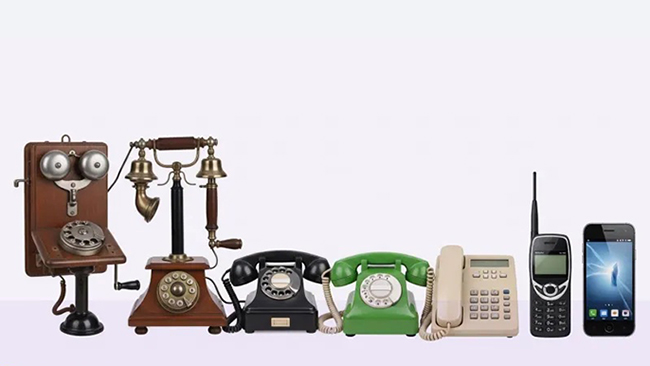
The Evolution of the Telephone: How Communication Changed the World
Communication is the heartbeat of human civilization. From smoke signals and carrier pigeons to the smartphones in our pockets, the journey of the telephone is a testament to human ingenuity. This is the story of how we bridged the gap between “here” and “there.”
The Pre-Electric Era: Acoustic Foundations
Before wires and signals, humans experimented with “acoustic telephones.” These were mechanical devices that transmitted sound through a physical medium.
- The String Telephone: Using two diaphragms connected by a taut string, people discovered that sound vibrations could travel over short distances.
- Speaking Tubes: Used in large estates and ships, these were pipes that carried the physical sound of a voice from one room to another.
While these weren’t “telephones” in the modern sense, they proved that human speech could be captured and moved.
1876: The Birth of the Electric Telephone
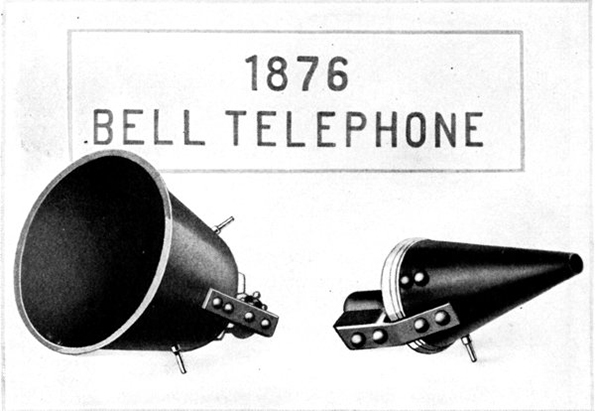
The 1870s were a period of intense scientific rivalry. While several inventors were working on “harmonic telegraphs,” Alexander Graham Bell emerged as the primary figure.
The Patent Race
On February 14, 1876, Bell filed his patent. Just hours later, Elisha Gray filed a caveat for a similar invention. Bell’s design won out, leading to the famous first words on March 10, 1876: “Mr. Watson, come here, I want to see you.”
How it Worked
Bell’s initial telephone converted sound into an electrical current that traveled through a wire and was then converted back into sound at the other end. It was rudimentary, but it proved that the human voice could travel through electricity.
The Late 1800s: The Switchboard Revolution
Initially, telephones were sold in pairs. If you wanted to talk to your neighbor and your office, you needed two separate lines and two separate phones.
The Rise of the Exchange
To solve this, Telephone Exchanges were created. These acted as hubs where all lines met.
- Manual Switchboards: Operators (mostly women) would manually plug cables into jacks to connect two callers.
- The First Operators: Originally, teenage boys were hired, but they were often too rowdy. Women were found to be more polite and efficient, leading to a new career path for women in the late 19th century.
The Early 20th Century: The Rotary Dial and Automation
As the number of users grew, manual switching became impossible to manage.
Almon Brown Strowger
Strowger, an undertaker, suspected that manual operators were diverting his business calls to competitors. In 1891, he patented the Automatic Telephone Exchange. This led to the creation of the Rotary Dial.
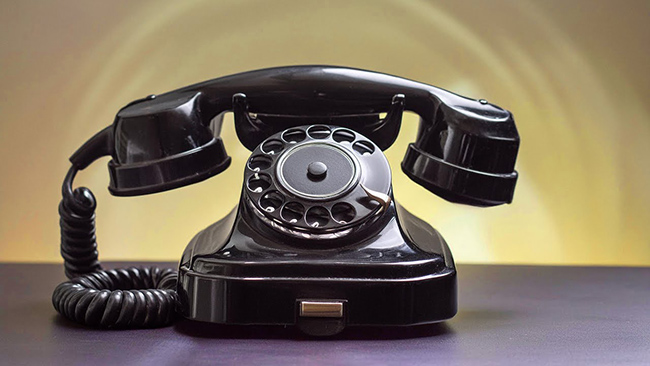
- The Rotary Era: Users could now “dial” a number themselves without needing an operator. This gave people privacy and revolutionized the speed of communication.
Mid-20th Century: Transatlantic Calls and Touch-Tone
By the 1940s and 50s, the telephone was a staple in the Western home.
The Transatlantic Cable (1956)
Before TAT-1 (the first transatlantic telephone cable), calls between Europe and America were handled via expensive and unreliable radio waves. The cable allowed for clear, instant intercontinental conversation.
Touch-Tone Dialing (1963)
Bell System introduced Dual-Tone Multi-Frequency (DTMF) technology, or “Touch-Tone.”
- The Benefit: Instead of waiting for a rotary wheel to spin back, users pressed buttons. Each button sent a specific sound frequency to the exchange, making dialing significantly faster.
The 1970s – 1980s: Going Mobile
The dream of a “car phone” had existed for decades, but the technology was bulky and limited to city-wide ranges.
The First Mobile Call (1973)
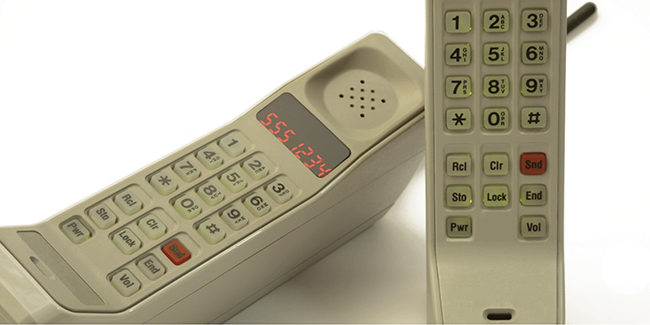
On April 3, 1973, Martin Cooper of Motorola made the first handheld cellular phone call to his rival at Bell Labs. He used the Motorola DynaTAC 8000X.
The “Brick” Phone
The DynaTAC was nearly 10 inches long and weighed 2.5 pounds. It offered 30 minutes of talk time and took 10 hours to charge. It was a luxury item, costing nearly $4,000 at the time.
The 1990s: The Digital Revolution and SMS
In the 90s, the shift from analog (1G) to digital (2G) signals changed everything.
- Size Reduction: Phones became pocket-sized (e.g., the Nokia 3310).
- The SMS: In 1992, the first text message (“Merry Christmas”) was sent. Texting became a global phenomenon, changing the way we interact.
- The BlackBerry: Introduced the concept of “mobile email,” making the phone a tool for the professional world.
2007: The Smartphone Era (The iPhone Impact)
While smartphones existed (like the Palm Pilot), the iPhone launch in 2007 changed the trajectory of human history.
The Convergence
The telephone was no longer just for talking. It became:
- A Camera
- An Internet Browser
- A Music Player (iPod)
- A GPS Device
The App Store (2008) allowed third-party developers to turn the phone into a Swiss Army knife for the digital age.
The Modern Era: 5G, AI, and VoIP
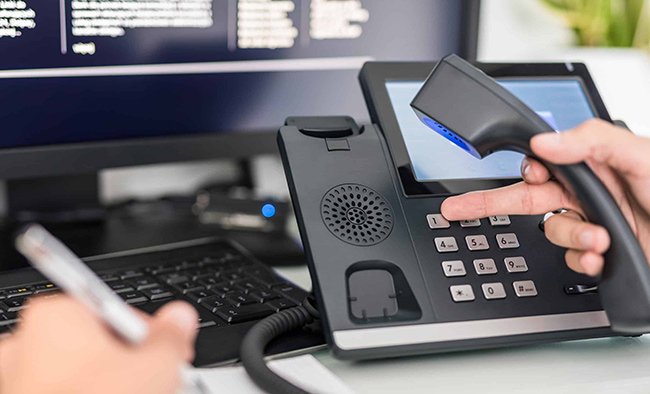
Today, we are in the era of 5G and VoIP (Voice over IP). We no longer rely on traditional copper wires; our voices travel as data packets over the internet.
- Artificial Intelligence: Real-time translation, noise cancellation, and voice assistants (Siri, Google) are standard.
- Foldables: Companies like Samsung are returning to the “flip” form factor but with flexible glass screens.
- Video Calling: Zoom and FaceTime have made the original “video phone” dreams of the 1960s a daily reality.
The Future: What’s Next?
We are moving toward a “post-device” world.
- Wearables: Smart glasses and watches are reducing our screen time.
- Neural Links: Scientists are exploring brain-computer interfaces where communication might happen via thought.
Summary Table: Evolution at a Glance
| Era | Key Technology | Main Characteristic |
| 1876 | Liquid Transmitter | The first successful voice transmission. |
| 1890s | Manual Switchboards | Human operators connected calls. |
| 1919 | Rotary Dial | Automation and user privacy. |
| 1963 | Touch-Tone | Push-button speed and DTMF. |
| 1983 | Motorola DynaTAC | The first commercial mobile phone. |
| 1990s | 2G & SMS | Digital signals and text messaging. |
| 2007 | iPhone / Android | The birth of the modern smartphone. |
| 2020s | 5G & AI | High-speed data and smart integration. |
The evolution of the telephone is a journey from physical wires to invisible waves. It has shrunk the world, allowing us to maintain relationships across oceans and conduct business in real-time. As we look toward the future, the “telephone” may disappear into our clothing or even our bodies, but the core purpose remains the same: The human need to connect.
Sources
AT&T Archives and History Center
IEEE Xplore (Institute of Electrical and Electronics Engineers)
Smithsonian Institution: Excellent for details on the original Bell patents and early 19th-century prototypes.
Apple Newsroom / Samsung Global Newsroom: For specific details regarding the “Smartphone Revolution” era
Library of Congress: For primary documents, original sketches by Alexander Graham Bell, and historical photographs.
The Guinness World Records: Good for “firsts,” such as the first mobile phone call or the most sold phone (Nokia 1100).
.

