

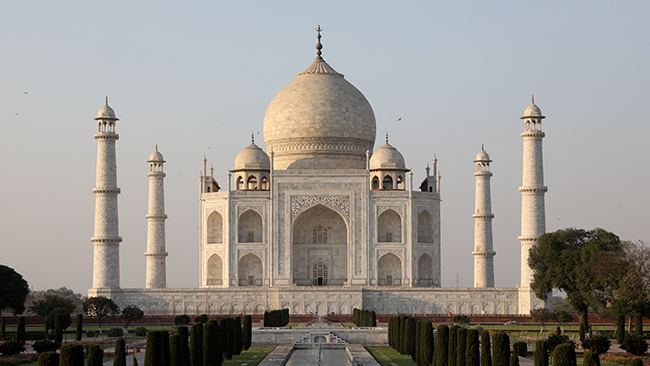
Taj Mahal: The Eternal Symbol of Love and Mughal Grandeur
The Taj Mahal is one of the most celebrated monuments in the world and a timeless symbol of love, beauty, and architectural brilliance. Located in Agra, Uttar Pradesh, India, this magnificent white-marble mausoleum was built in the 17th century by the Mughal Emperor Shah Jahan in memory of his beloved wife Mumtaz Mahal.
Recognized as a UNESCO World Heritage Site in 1983 and one of the New Seven Wonders of the World, the Taj Mahal stands not only as a monument of personal devotion but also as a peak achievement of Mughal architecture, blending Persian, Islamic, and Indian styles.
More than just a tomb, the Taj Mahal represents the cultural richness, political power, artistic excellence, and spiritual ideals of the Mughal Empire at its height. Over centuries, it has inspired poets, historians, travelers, architects, and millions of visitors from across the globe.
Historical Background
The Mughal Empire in the 17th Century
The Taj Mahal was built during the reign of Shah Jahan (r. 1628–1658), the fifth Mughal emperor and one of the greatest patrons of art and architecture in Indian history. The Mughal Empire at this time was politically stable, economically prosperous, and culturally vibrant. Shah Jahan’s era is often considered the Golden Age of Mughal architecture, marked by refined aesthetics, symmetry, and monumental scale.
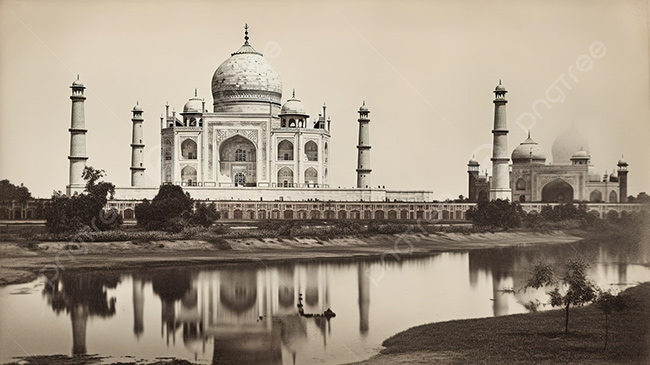
Shah Jahan and Mumtaz Mahal
Mumtaz Mahal, born Arjumand Banu Begum, was Shah Jahan’s favorite wife and constant companion. She died in 1631 while giving birth to their 14th child during a military campaign in the Deccan. Her death deeply devastated the emperor. According to historical accounts, Shah Jahan mourned intensely and resolved to build the most beautiful mausoleum ever seen as a tribute to her memory.
Construction of the Taj Mahal began in 1632 and was largely completed by 1648, though surrounding structures and decorative elements continued until about 1653.
Meaning of the Name “Taj Mahal”
The name “Taj Mahal” is believed to be derived from Mumtaz Mahal’s name and is often translated as “Crown of the Palace.” It reflects both her royal status and the monument’s symbolic role as the crowning jewel of Mughal architecture.
Architectural Design and Layout
Overall Plan
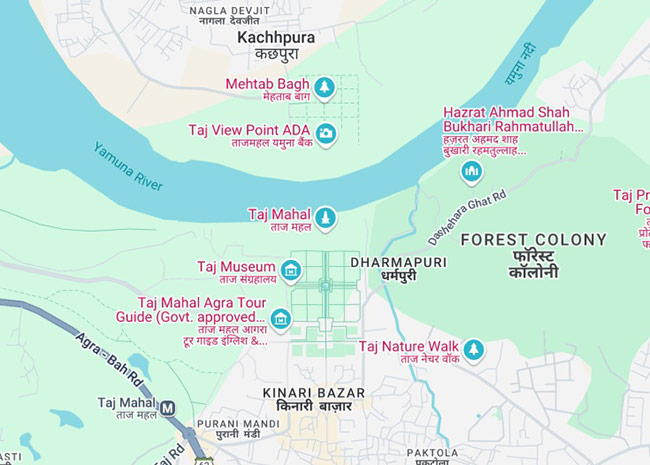
The Taj Mahal complex is laid out along the southern bank of the Yamuna River and follows the principles of charbagh, a Persian-style four-part garden symbolizing paradise as described in Islamic tradition.
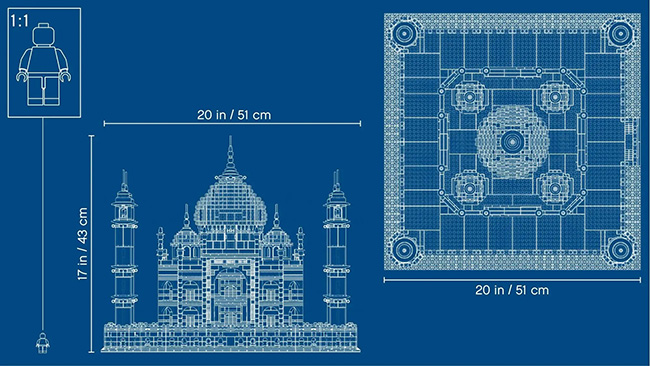
The complex includes:
- The main mausoleum
- A grand garden
- A mosque (to the west)
- A jawab or guest house (to the east)
- Monumental gateways
- Reflecting pools and walkways
Perfect symmetry governs the entire design, reinforcing a sense of balance, harmony, and divine order.
The Mausoleum
Structure and Materials
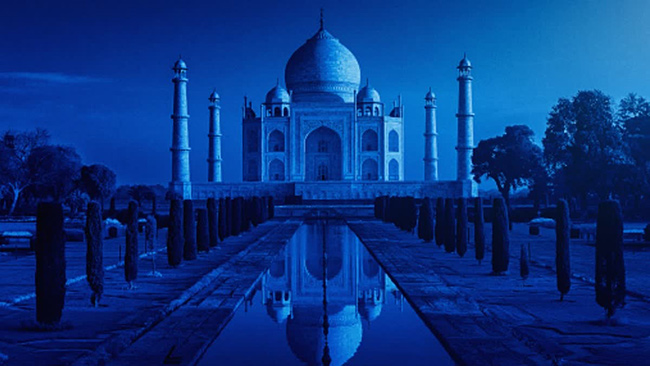
The main mausoleum is built entirely of white Makrana marble, quarried from Rajasthan. It stands on a square marble platform and rises to a height of about 73 meters (240 feet).
Key features include:
- A massive central dome
- Four smaller domed kiosks (chhatris)
- Four slender minarets placed at the corners
The minarets lean slightly outward, a deliberate design choice to ensure that in case of an earthquake they would fall away from the tomb rather than onto it.
The Dome
The iconic onion-shaped dome, often called the “dome of love,” is one of the most striking features of the Taj Mahal. It rises gracefully above the structure and is crowned by a finial combining Islamic and Hindu decorative elements.
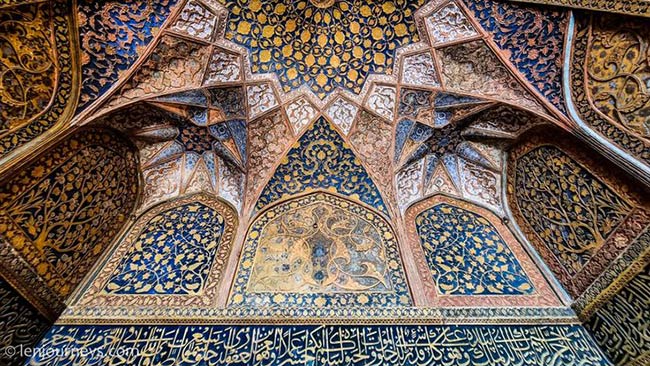
Interior Decoration
Cenotaphs and the Burial Chamber
Inside the mausoleum lie the cenotaphs (symbolic tombs) of Mumtaz Mahal and Shah Jahan, while the actual graves are located in a lower chamber below. Mumtaz’s cenotaph occupies the central position, emphasizing her importance.
Pietra Dura and Calligraphy
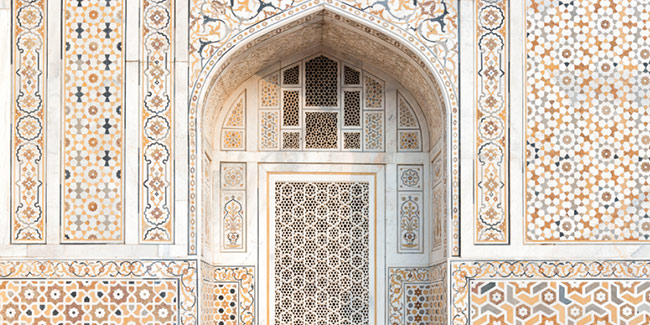
The interior walls are decorated with pietra dura (parchin kari), an intricate inlay technique using semi-precious stones such as jade, lapis lazuli, turquoise, and onyx. Floral patterns and vines symbolize paradise and eternal life.
Verses from the Qur’an, rendered in elegant black marble calligraphy, adorn the entrance arches. The calligraphy increases in size as it rises, maintaining visual uniformity when viewed from below—an example of remarkable optical precision.
The Gardens: Symbol of Paradise
The Taj Mahal garden is divided into four symmetrical quadrants by water channels, representing the four rivers of paradise mentioned in Islamic texts. Cypress trees symbolize death, while fruit-bearing trees represent life, reinforcing the theme of eternal existence.
Unlike earlier Mughal tombs, where the mausoleum stood at the center of the garden, the Taj Mahal is positioned at the northern end, overlooking the river—possibly symbolizing the boundary between the earthly world and the afterlife.
Construction and Workforce
It is estimated that over 20,000 artisans, craftsmen, calligraphers, stonecutters, and laborers worked on the Taj Mahal. Specialists were brought from across India and Central Asia.
Materials used came from far and wide:
- Marble from Rajasthan
- Jade and crystal from China
- Turquoise from Tibet
- Lapis lazuli from Afghanistan
- Sapphire from Sri Lanka
A temporary town, known as Mumtazabad, was established to house workers during construction.
Myths and Legends
The Black Taj Mahal
One popular legend claims that Shah Jahan intended to build a second, identical mausoleum in black marble across the river for himself, known as the “Black Taj.” While intriguing, historians largely dismiss this theory due to lack of reliable evidence.
Mutilation of Craftsmen
Another myth suggests that Shah Jahan ordered the hands of the craftsmen to be cut off to prevent replication of the Taj Mahal. This story has no historical basis and is considered a romanticized fabrication.
Decline and Preservation
Later Mughal Period
After Shah Jahan was deposed by his son Aurangzeb, he spent his final years imprisoned in Agra Fort, gazing at the Taj Mahal from a distance. He was buried beside Mumtaz Mahal upon his death in 1666, disrupting the perfect symmetry of the tomb.
British Period
During British rule, the Taj Mahal suffered neglect and vandalism. Some precious stones were removed, and the gardens were altered. However, Lord Curzon later initiated restoration efforts in the early 20th century.
Modern Conservation Challenges
Today, the Taj Mahal faces several threats:
- Air pollution causing marble discoloration
- Acid rain and industrial emissions
- Overcrowding from millions of tourists annually
- Environmental degradation of the Yamuna River
To combat these issues, the Indian government established the Taj Trapezium Zone (TTZ), restricting industrial activity around the monument and promoting conservation measures.
Cultural and Global Significance
The Taj Mahal has inspired:
- Poets like Rabindranath Tagore, who called it “a teardrop on the cheek of time”
- Painters, filmmakers, and writers worldwide
- Architectural designs across cultures
It stands as a universal symbol of love, grief, devotion, and artistic perfection.
Taj Mahal Map
UNESCO World Heritage Status
In 1983, UNESCO recognized the Taj Mahal as a World Heritage Site, praising it as “the jewel of Muslim art in India and one of the universally admired masterpieces of the world’s heritage.”
The Taj Mahal is far more than a marble monument—it is a story carved in stone, a reflection of human emotion, imperial ambition, and artistic genius. Built from love, shaped by faith, and preserved through centuries, it continues to captivate humanity with its silent eloquence.
As long as the Taj Mahal stands on the banks of the Yamuna, it will remain a reminder that love can transcend time, and beauty can achieve immortality.
Sources
UNESCO World Heritage Centre – Taj Mahal
Oxford History of India / Mughal History Books
Archaeological Survey of India (ASI) – Taj Mahal
History.com – Taj Mahal, For simplified history and narrative-based story
Britannica – Taj Mahal, For general history, construction timeline, and overview
National Geographic – Taj Mahal, For cultural significance and photography-based features

