

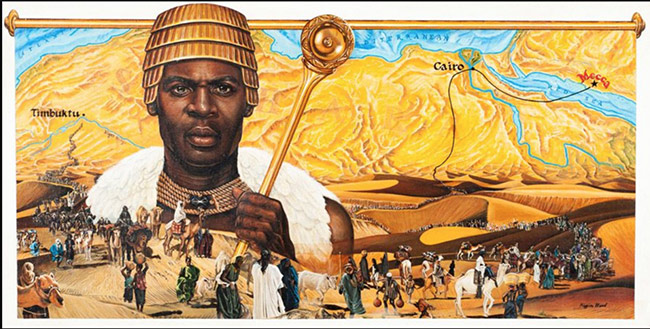
The Golden King: How Mansa Musa I Became the Richest Human in History
In the annals of human history, many names are synonymous with power and riches—Rockefeller, Rothschild, Augustus Caesar. Yet, according to historians, none of them truly compare to a 14th-century West African monarch named Mansa Musa. As the ruler of the Mali Empire, Musa I presided over a realm so rich in natural resources that his personal net worth is often described as “incalculable” or “indescribable.”
However, to remember Mansa Musa only for his gold is to overlook one of the most sophisticated political and cultural eras in African history. His reign (c. 1312 – c. 1337) transformed Mali into a global epicenter of trade, education, and Islamic scholarship.
I. The Rise of the Mali Empire
To understand the man, one must understand the land. The Mali Empire rose from the ruins of the Ghana Empire, gaining dominance over the vital trans-Saharan trade routes. By the time Musa took the throne, Mali was the largest producer of gold in the world.
The Accidental Ascension
Musa came to power through a unique set of circumstances. According to the Arab historian Al-Umari, Musa’s predecessor, Mansa Abu Bakr II, became obsessed with what lay beyond the Atlantic Ocean. He abdicated his throne to lead an expedition of 2,000 ships to explore the “limits of the ocean.” He never returned, and Musa, who had been appointed as deputy, was crowned the tenth Mansa (King of Kings) of Mali.
II.The Rise of the Mali Empire
While modern billionaires derive wealth from tech or finance, Musa’s wealth was physical and literal. The Mali Empire sat atop three massive gold mines: Bambuk, Boure, and Galam.
- Gold and Salt: In the medieval world, salt was as valuable as gold, used for food preservation and as a basic mineral. Mali controlled the northern salt mines and the southern gold mines, effectively taxing every ounce of trade that moved across West Africa.
- The Power of Logistics: Musa’s administration was highly organized. He divided the empire into provinces, each ruled by a farba (governor). This stability allowed trade to flourish without the threat of bandits, ensuring a steady flow of tax revenue to the royal treasury.
III. The Journey That Changed the World: The Hajj of 1324
Mansa Musa remained largely unknown to the world outside West Africa until 1324, when he embarked on his religious pilgrimage (Hajj) to Mecca. This was not a quiet journey of devotion; it was perhaps the most extravagant PR campaign in history.
The Caravan of 60,000
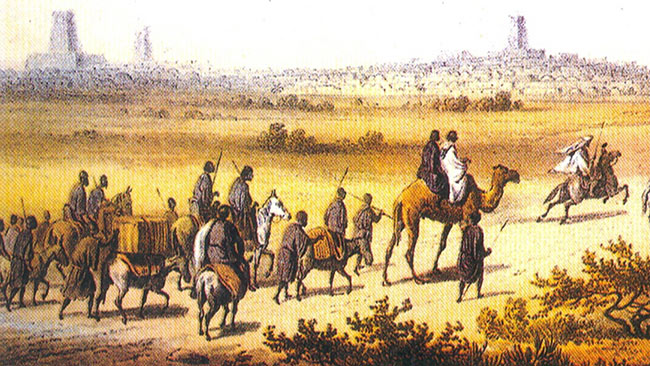
Imagine a line of people stretching as far as the eye could see across the Sahara Desert. Musa’s caravan reportedly included:
- 60,000 men, including soldiers, heralds, and subjects.
- 12,000 servants, each carrying a 4-pound bar of solid gold.
- 80 camels, each loaded with 50 to 300 pounds of gold dust.
- Royal silk: Even the slaves were dressed in the finest Persian silks and brocade.
Crashing the Egyptian Economy
When the caravan reached Cairo, Musa’s generosity became his most famous trait—and an economic disaster. He gave away so much gold to the poor and spent so much in the local markets that the sudden influx of the precious metal caused its value to plummet.
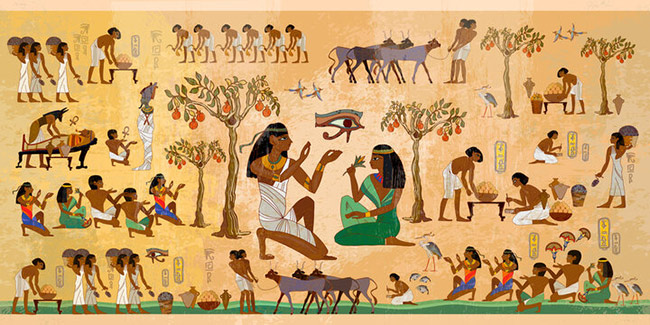
Economic records show that the price of gold in Egypt stayed depressed for over 12 years, leading to massive inflation. It is the only time in history that a single man controlled the price of gold on a global scale.
IV. Timbuktu: The Intellectual Renaissance
Musa did not return from Mecca just with stories; he brought back scholars, architects, and poets. He was determined to turn Mali into an intellectual powerhouse.
The University of Sankore
Musa transformed the city of Timbuktu into an international hub. He funded the Sankore University, which housed one of the largest libraries in the world since the Library of Alexandria. At its peak, the university could hold 25,000 students and possessed over 700,000 manuscripts covering subjects like:
- Astronomy and Mathematics
- Medicine and Surgery
- Islamic Law and Philosophy
The Great Mosque of Djinguereber
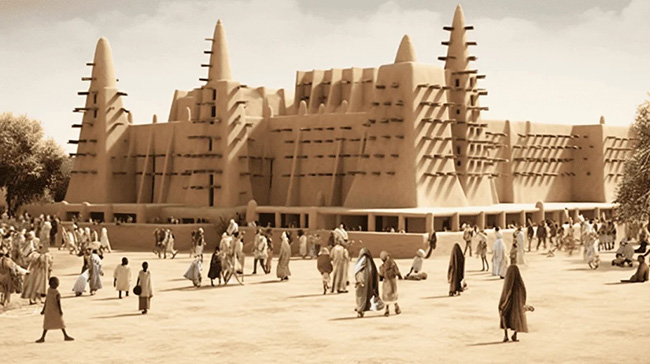
One of the architects Musa brought back, Abu Ishaq al-Sahili, was paid 200 kilograms of gold (worth roughly $12 million today) to design the Djinguereber Mosque. Built with mud bricks and wood, the mosque’s unique Sudano-Sahelian style remains an iconic symbol of African architecture today.
V. Mali in the Global Eye: The Catalan Atlas
The impact of Musa’s pilgrimage was so profound that mapmakers in Europe—who previously viewed West Africa as a void—began to take notice.
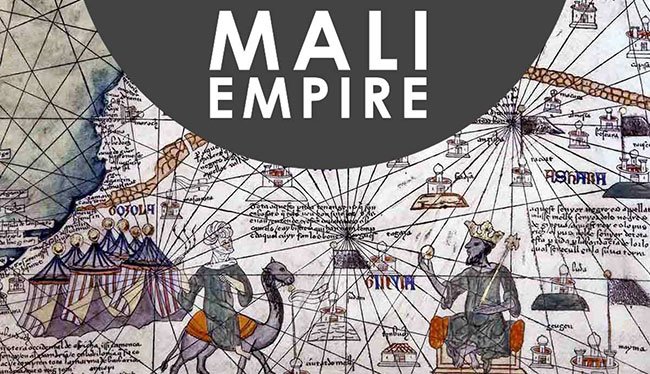
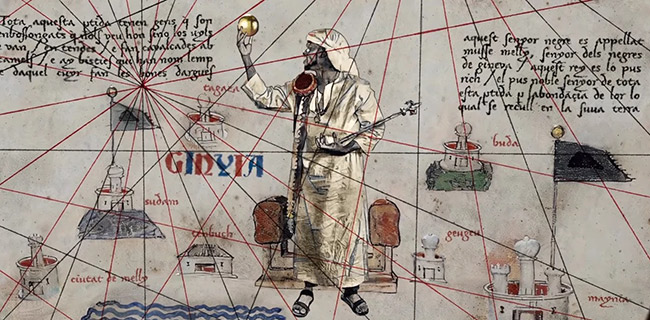
In the 1375 Catalan Atlas, created by Abraham Cresques, Mansa Musa is prominently featured. He is depicted sitting on a golden throne, wearing a crown, and holding a scepter and a large gold nugget.
The caption described him as the “richest and most noble King of all the land.” This map was the primary way Europeans learned about the wealth of Africa, eventually fueling the Age of Discovery.
VI. Governance and Justice
While the gold gets the headlines, Musa’s governance was equally impressive. He was known for being a devout Muslim but was also religiously tolerant, allowing his subjects to practice their traditional beliefs.
The security within his empire was legendary. Travel writers of the time, such as Ibn Battuta (who visited shortly after Musa’s death), noted that a traveler could carry a bag of gold from one end of the empire to the other without fear of theft. Musa established a rigorous judicial system that promoted equity and trade stability.
VII. The End of an Era
Mansa Musa died around 1337. He was succeeded by his son, Mansa Maghan, and later by his brother, Mansa Suleyman. While the empire continued to thrive for some time, it eventually succumbed to internal civil wars and the rise of the Songhai Empire.
However, the foundations Musa laid—the mosques, the libraries, and the reputation of Timbuktu—ensured that Mali’s Golden Age would never be forgotten.
Why Mansa Musa Matters Today
In modern discourse, African history is often mistakenly viewed through the lens of colonialism or poverty. Mansa Musa stands as a powerful rebuttal to those narratives. He was a man of immense faith, a patron of education, and a visionary leader who built a globalized state long before the modern era.
His story is a reminder that the “dark ages” in Europe were, in fact, the “Golden Age” for West Africa. Today, as we calculate the net worth of tech moguls, Mansa Musa remains the ultimate benchmark of wealth—not just in terms of gold, but in his enduring contribution to human knowledge and culture.
The story of Mansa Musa I is far more than a glittering tale of gold and extravagance; it is a testament to a sophisticated African civilization that commanded the respect and awe of the medieval world.
While his staggering net worth—often estimated at $400 billion—is what captures modern headlines, his true wealth was measured in the mosques he built, the libraries he filled, and the stability he brought to a vast, diverse empire.
By turning Timbuktu into a global “city of light” for scholars and scientists, Musa ensured that Mali’s influence would outlast its gold reserves. He bridged the gap between West Africa and the Mediterranean, forcing the cartographers of Europe to acknowledge the power and prestige of his realm.
Today, Mansa Musa stands as a powerful symbol of African excellence and intellectual ambition. He serves as a reminder that history is not just written by those with the most gold, but by those who use their resources to advance human knowledge and culture.
As we look back at the 14th century, Musa I remains not just the wealthiest man to have ever lived, but one of the most visionary architects of a globalized world.
Reference
UNESCO World Heritage Centre: Specifically records on Timbuktu and the Djinguereber Mosque.
National Geographic Society: Extensive educational resources on the Mali Empire’s geography and trade.

