

Lighthouse of Alexandria: The Lost Wonder That Lit the Ancient World
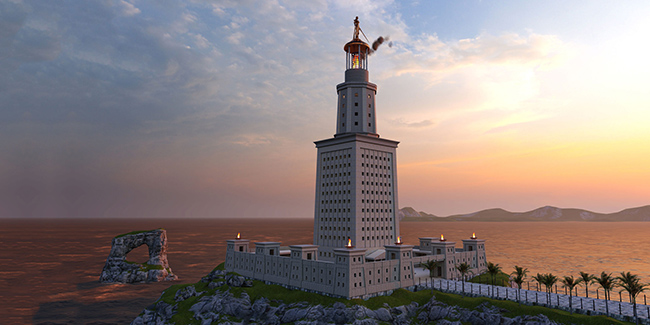
The Lighthouse of Alexandria, also known as the Pharos of Alexandria, was one of the most remarkable architectural and technological achievements of the ancient world. Built on the small island of Pharos near the Egyptian city of Alexandria, it stood as a symbol of human ingenuity, scientific advancement, and maritime power.
For centuries, the lighthouse guided sailors safely into one of the busiest ports of the ancient Mediterranean and became so famous that the word “pharos” itself came to mean “lighthouse” in many languages.
Recognized as one of the Seven Wonders of the Ancient World, the Lighthouse of Alexandria was not merely a navigational aid—it was a monument to the ambition of the Hellenistic age and the cultural fusion of Greek, Egyptian, and Near Eastern traditions. Although it no longer stands today, its legacy continues to influence lighthouse design and maritime navigation even in the modern era.
Historical Background
Foundation of Alexandria
The city of Alexandria was founded in 331 BCE by Alexander the Great during his campaign in Egypt. Strategically located on the Mediterranean coast, Alexandria quickly developed into a major center of trade, learning, and culture. After Alexander’s death, Egypt came under the rule of Ptolemy I Soter, one of his generals, who established the Ptolemaic Dynasty.
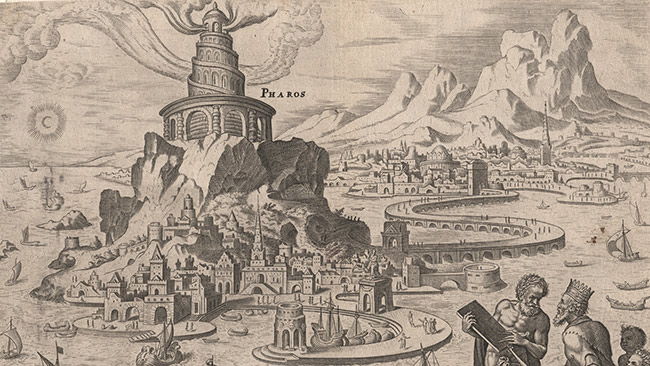
As Alexandria grew into a powerful maritime hub, its busy harbor became increasingly difficult to navigate. The coastline was flat and rocky, and dangerous reefs lay hidden beneath the water. A monumental lighthouse was needed to guide ships safely into the harbor.
Construction of the Lighthouse
Patron and Architect
The Lighthouse of Alexandria was commissioned by Ptolemy I Soter around 300 BCE, but construction was completed during the reign of his son, Ptolemy II Philadelphus, around 280 BCE.
The architect traditionally credited with its design is Sostratus of Cnidus, a Greek engineer and architect. According to ancient accounts, Sostratus cleverly inscribed his own name on the lighthouse beneath a layer of plaster bearing the king’s dedication, ensuring his legacy would endure after the plaster eroded.
Location: The Island of Pharos
The lighthouse was built on the island of Pharos, which lay just off the coast of Alexandria. A massive causeway called the Heptastadion connected the island to the mainland, dividing Alexandria’s harbor into eastern and western ports. The lighthouse stood at the eastern entrance, perfectly positioned to guide incoming ships.
Architectural Design and Structure
Height and Scale
The Lighthouse of Alexandria was among the tallest man-made structures in the ancient world, with estimated heights ranging between 100 and 145 meters (330–475) feet . For comparison, it was taller than most modern 40-story buildings.
Three-Tier Design
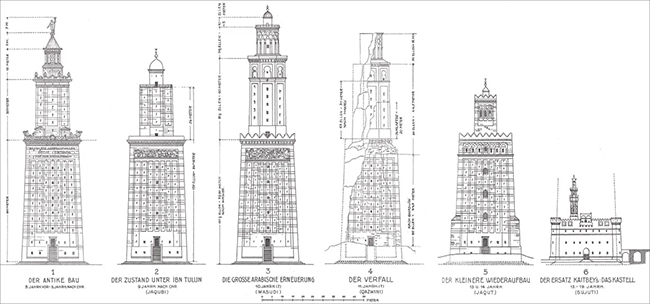
Ancient descriptions suggest the lighthouse had a three-tiered structure:
Square Base
- Massive and solid
- Contained administrative rooms and storage
- Built with large limestone blocks
Octagonal Middle Section
- More slender and decorative
- Likely housed a ramp or staircase
Cylindrical Upper Section
- Topped by a platform where the light was produced
- Possibly crowned with a statue of Zeus, Poseidon, or Helios
Materials and Engineering
The lighthouse was primarily constructed from limestone, bonded with molten lead to protect against erosion from waves and earthquakes. Its interior featured a ramped passage wide enough for animals to carry fuel to the top.
This level of engineering demonstrated advanced knowledge of geometry, physics, and material science, making the lighthouse a marvel of ancient construction.
The Light Mechanism
Fire and Reflection
At night, a large fire burned at the top of the lighthouse. During the day, sunlight was reflected outward using a polished bronze mirror. Ancient writers claimed the light could be seen from distances of up to 50 kilometers (30 miles).
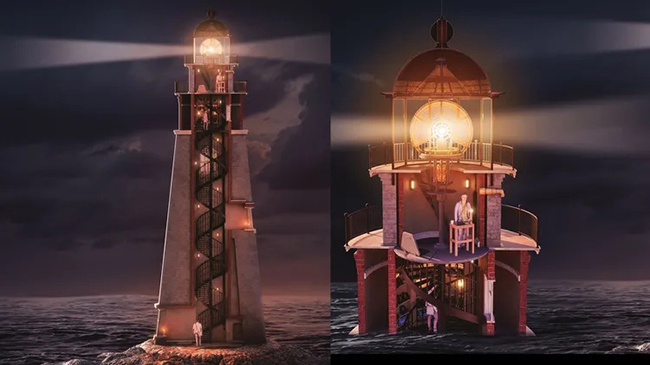
Some legends even suggested that the mirror could focus sunlight to burn enemy ships, though this is likely exaggerated or mythical.
Purpose and Function
Maritime Navigation
The lighthouse’s primary role was to guide ships safely into Alexandria’s harbor, preventing shipwrecks and protecting valuable cargo. It was especially vital during storms or fog.
Symbol of Power and Knowledge
Beyond its practical function, the lighthouse symbolized:
- The power of the Ptolemaic kingdom
- Alexandria’s status as a global center of trade
- The scientific spirit of the Hellenistic world
Along with the Great Library of Alexandria, the lighthouse represented humanity’s quest for knowledge and mastery over nature.
Cultural and Linguistic Legacy
The Lighthouse of Alexandria had an enormous cultural impact. The word “Pharos” became synonymous with lighthouse and survives in many languages:
- French: phare
- Italian: faro
- Spanish: faro
- Greek: pharos
It also inspired countless architectural imitations in the Roman and Islamic worlds.
Decline and Destruction
Earthquake Damage
The lighthouse stood for over 1,600 years, an extraordinary lifespan for an ancient structure. However, a series of earthquakes between the 10th and 14th centuries CE gradually damaged it.
Major earthquakes occurred in:
- 956 CE
- 1303 CE
- 1323 CE
These disasters severely weakened the structure, causing large portions to collapse.
Final Disappearance
By the late 14th century, the lighthouse was completely ruined. In 1477 CE, the Mamluk Sultan Qaitbay used the remaining stones to build the Citadel of Qaitbay, which still stands on the site today.
Archaeological Discoveries
Underwater Ruins
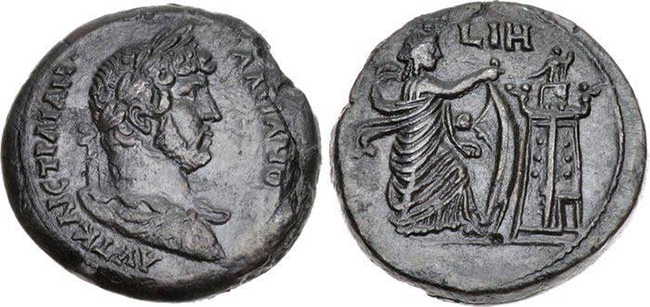
In the late 20th century, underwater archaeologists discovered massive stone blocks, columns, and statues submerged near the harbor of Alexandria. These remains are widely believed to be parts of the Lighthouse of Alexandria.
Modern Research
Advanced sonar scanning and diving expeditions have helped reconstruct the lighthouse’s appearance, confirming ancient descriptions and highlighting its immense scale.
Why the Lighthouse Was a Wonder
The Lighthouse of Alexandria earned its place among the Seven Wonders of the Ancient World because of:
- Its unprecedented height
- Advanced engineering techniques
- Dual practical and symbolic importance
- Long-lasting influence on architecture and navigation
Unlike many ancient monuments, it served everyday human needs while also inspiring awe.
Legacy and Influence
Although destroyed, the Lighthouse of Alexandria left a lasting legacy:
- It became the prototype for all future lighthouses
- Influenced Islamic minaret design
- Remains a symbol of guidance, knowledge, and safety
- Continues to inspire historians, architects, and travelers
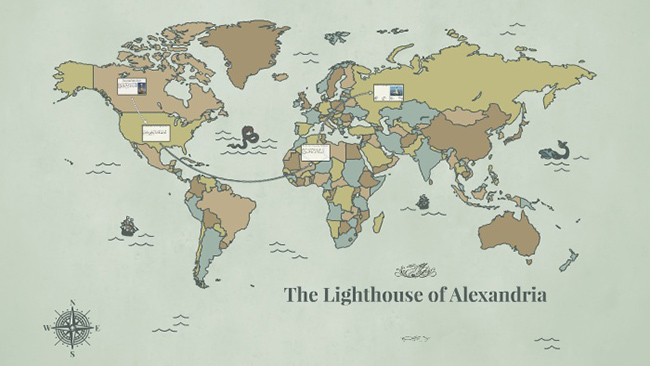
Lighthouse of Alexandria Map
The Lighthouse of Alexandria was more than stone and fire—it was a beacon of civilization itself. Rising above the Mediterranean for centuries, it guided sailors, showcased scientific brilliance, and embodied the ambition of the Hellenistic world. Though time and earthquakes have erased it from the skyline, its memory continues to shine brightly in human history.
As one of the greatest achievements of the ancient world, the Lighthouse of Alexandria remains a timeless symbol of humanity’s desire to illuminate the unknown and guide the path forward.
Sources
The Encyclopedia Britannica – Entry: “Lighthouse of Alexandria”
Oxford Classical Dictionary (Academic reference on Hellenistic engineering)
UNESCO World Heritage Centre – Alexandria and its ancient harbor studies
McKenzie, Judith – The Architecture of Alexandria and Egypt (Detailed architectural analysis)
Jean-Yves Empereur, Alexandria Rediscovered (Underwater archaeology and lighthouse remains)

