

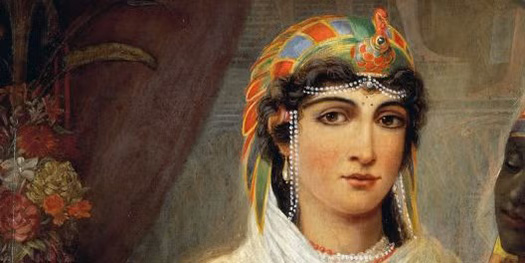
Cleopatra’s Beauty and Political Strategy: The Truth Behind the Legend
Cleopatra VII Philopator, the last active ruler of the Ptolemaic Kingdom of Egypt, remains one of history’s most fascinating and misunderstood figures. For over two millennia, her name has been synonymous with legendary beauty, seduction, and romance. Yet beneath the layers of myth, poetry, and later Roman propaganda lies a ruler of extraordinary intelligence, cultural sophistication, and political skill.
Cleopatra’s true power did not rest solely in physical appearance, but in her ability to wield charm, intellect, language, and strategy as tools of statecraft in a world dominated by Rome.
This article explores Cleopatra’s beauty as both reality and myth, and more importantly, her political strategies, which allowed her to survive—and briefly thrive—during one of the most dangerous periods in Mediterranean history.
Cleopatra’s Background: A Queen in a Man’s World
Cleopatra was born in 69 BCE into the Ptolemaic dynasty, a Greek royal house founded by Ptolemy I Soter, one of Alexander the Great’s generals. Although she ruled Egypt, Cleopatra was not ethnically Egyptian, her ancestry was primarily Macedonian Greek. However, unlike many of her predecessors, she embraced Egyptian culture deeply.
From an early age, Cleopatra was trained to rule. She received a classical Hellenistic education, studying philosophy, rhetoric, mathematics, astronomy, medicine, and history.
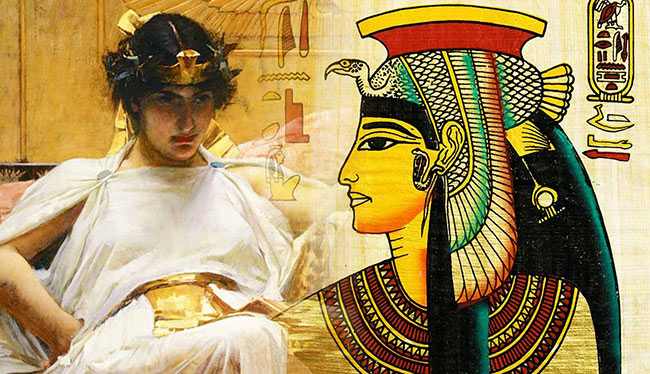
Ancient sources suggest she spoke at least seven languages, including Greek, Egyptian, Latin, Hebrew, Aramaic, and Ethiopian—an unprecedented skill among Ptolemaic rulers. This linguistic mastery allowed her to communicate directly with foreign envoys and Egyptian subjects without translators, strengthening her authority.
Cleopatra ascended the throne at around 18 years old, initially ruling jointly with her younger brother Ptolemy XIII, according to Egyptian custom. However, political rivalry soon erupted, leading to civil war—an early test of her strategic instincts.
Cleopatra’s Beauty: Reality vs. Legend
Ancient Descriptions
Contrary to popular imagination, ancient writers did not unanimously describe Cleopatra as extraordinarily beautiful in a purely physical sense. Plutarch, one of the most important ancient sources, famously wrote:
“Her beauty was not in itself so remarkable that none could be compared with her… but the charm of her presence was irresistible.”
This statement is crucial. Cleopatra’s allure came from a combination of intelligence, charisma, voice, wit, and confidence, rather than flawless physical features alone.
Coins and Portraits
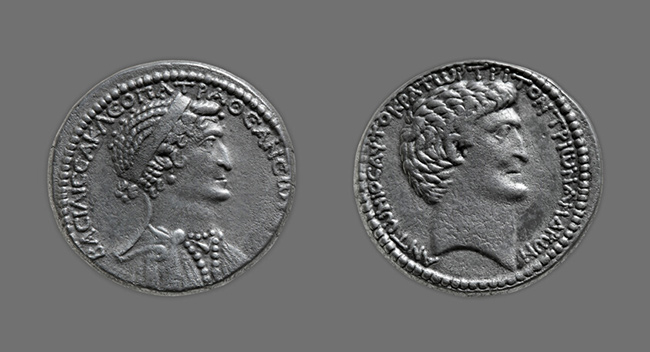
Surviving coins minted during Cleopatra’s reign depict her with a strong nose, prominent chin, and angular features, more consistent with royal realism than idealized beauty. These portraits emphasize authority rather than softness—suggesting Cleopatra wanted to be seen as a ruler first, not merely a consort.
Beauty as Performance
Cleopatra understood beauty as a political performance. She used luxurious clothing, symbolic colors, cosmetics, perfumes, and carefully staged appearances to project divine legitimacy and royal splendor. By associating herself with Isis, the Egyptian goddess of motherhood and magic, she elevated her image from queen to living deity.
Thus, Cleopatra’s beauty was strategic—crafted, controlled, and culturally resonant.
The Art of Seduction as Diplomacy
In the ancient world, personal relationships were inseparable from politics. Cleopatra mastered this reality better than most rulers of her time.
Cleopatra and Julius Caesar
When Cleopatra was forced into exile during her conflict with Ptolemy XIII, she faced political extinction. Her bold solution was legendary.
According to tradition, Cleopatra had herself smuggled into Julius Caesar’s quarters wrapped in a carpet (or linen sack). Whether literal or symbolic, the act demonstrated her daring intelligence and understanding of theater.
Cleopatra did not merely seduce Caesar; she convinced him. She presented herself as a legitimate ruler, a valuable ally, and the key to Egypt’s stability—a crucial Roman interest.
Caesar restored her to the throne, defeated her rivals, and allowed her to rule Egypt as queen. Their relationship produced a son, Ptolemy XV Caesarion, whom Cleopatra proclaimed as Caesar’s heir.
Through Caesar, Cleopatra secured:
- Political legitimacy
- Military protection
- Economic independence
- Time to strengthen her rule
This alliance was diplomacy at its most personal—and effective.
Cleopatra as a Political Reformer
Cleopatra was not a passive ruler dependent on Roman men. She governed actively and decisively.
Economic Policy
Egypt was the breadbasket of the Mediterranean, supplying grain to Rome. Cleopatra carefully managed grain exports, ensuring Egypt remained indispensable but not vulnerable.
She reformed taxation, stabilized currency, and controlled inflation during periods of famine and civil unrest. Papyrus records show her direct involvement in administrative decisions—rare evidence of a hands-on ancient queen.
Religious Strategy
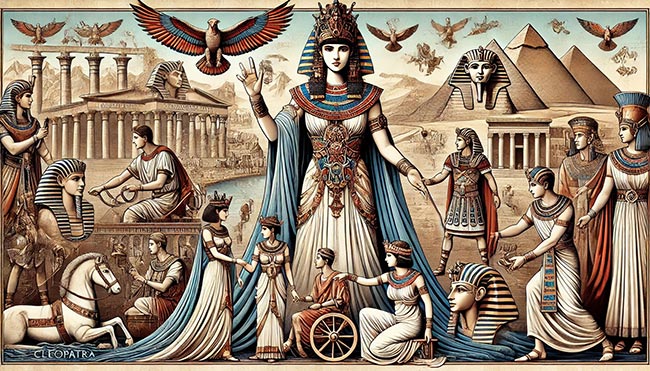
Cleopatra aligned herself with Egyptian religious traditions, presenting herself as the reincarnation of Isis. This was a calculated move to gain popular support among native Egyptians, who had often viewed Ptolemaic rulers as foreign overlords.
By blending Greek royal authority with Egyptian divine symbolism, Cleopatra became a unifying figure in a divided kingdom.
Cleopatra and Mark Antony: Power, Not Romance
The relationship between Cleopatra and Mark Antony is often portrayed as a tragic love story. In reality, it was a political alliance between two powerful figures seeking to challenge Rome’s future ruler, Octavian (later Augustus).
The Meeting at Tarsus
Cleopatra’s arrival to meet Antony in 41 BCE was theatrical genius. She arrived on a gilded barge, dressed as Aphrodite, surrounded by incense, music, and luxury. Antony, known for his love of spectacle, was immediately captivated—but more importantly, impressed.
Cleopatra offered Antony:
- Wealth
- Naval power
- Strategic eastern alliances
Antony offered Cleopatra:
- Territorial expansion
- Protection from Rome
- Recognition of her children as rulers
Together, they envisioned a new eastern empire, centered in Alexandria, independent of Roman control.
Propaganda and the Roman Smear Campaign
Cleopatra’s greatest enemy was not a battlefield general, but Roman propaganda.
Octavian launched a vicious campaign portraying Cleopatra as:
- A foreign temptress
- A corrupting influence on Antony
- A threat to Roman morality
By framing the conflict as a war against Cleopatra rather than Antony, Octavian gained public support in Rome.
This propaganda shaped Cleopatra’s legacy for centuries, transforming a capable ruler into a cautionary tale of female ambition.
Defeat and Death: The Final Act
The alliance collapsed after the defeat of Antony and Cleopatra’s forces at the Battle of Actium (31 BCE). Facing capture and humiliation, Cleopatra chose death.
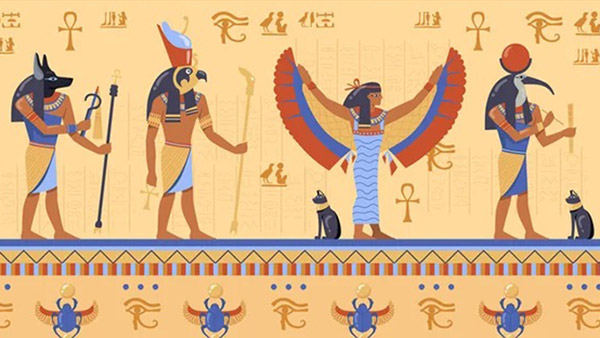
According to tradition, she died by the bite of an asp (cobra)—a symbol of royal divinity. Whether literal or poetic, her death was carefully staged to preserve dignity and control.
Cleopatra died not as a defeated captive, but as a queen asserting agency to the very end.
Cleopatra’s Legacy: Beauty Reconsidered
Cleopatra’s enduring image as a beautiful seductress obscures a deeper truth. Her greatest beauty lay in her mind—her ability to read people, command attention, navigate cultures, and survive in a brutal political landscape dominated by men.
She was:
- A multilingual intellectual
- A skilled economist
- A master of symbolism
- A fearless diplomat
Cleopatra ruled Egypt for 21 years, an extraordinary achievement given the era’s instability.
Cleopatra VII was far more than a beautiful queen who captivated powerful men. She was a political genius, a cultural bridge between worlds, and the last sovereign defender of ancient Egypt’s independence. Her beauty was not merely physical—it was strategic, intellectual, and performative.
History remembers Cleopatra not because she was Rome’s downfall, but because she dared to challenge it.
Sources
BBC History – Cleopatra – Accessible scholarly summaries
British Museum publications – Coinage, portraits, and archaeological interpretations
Oxford Classical Dictionary – Political and cultural background of the Ptolemaic period
Encyclopaedia Britannica, “Cleopatra VII Philopator” – Fact-checked reference material
Duane W. Roller, Cleopatra: A Biography – Academic and well-researched historical analysis

