

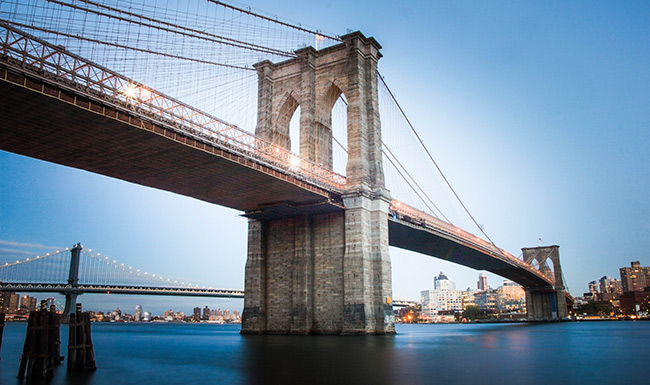
Brooklyn Bridge: The Timeless Marvel That United New York
The Brooklyn Bridge stands as one of the most recognizable and celebrated landmarks in the United States. Spanning the East River and connecting the boroughs of Manhattan and Brooklyn in New York City, the bridge is far more than a transportation link—it is a symbol of ambition, innovation, resilience, and the transformation of a growing nation.
Completed in the late 19th century, the Brooklyn Bridge represented a monumental leap forward in engineering and urban planning, redefining what was thought possible in bridge construction at the time.
Since its opening in 1883, the Brooklyn Bridge has played a crucial role in the social, economic, and cultural development of New York City. Today, it remains both a vital transportation artery and a beloved architectural masterpiece, admired by millions of pedestrians, cyclists, commuters, historians, artists, and tourists each year.
Geographical Setting and Purpose
The Brooklyn Bridge crosses the East River, linking Lower Manhattan with what was once the independent City of Brooklyn. Before the bridge’s construction, ferries were the primary means of crossing the river, often disrupted by ice, fog, and overcrowding. As New York’s population expanded rapidly during the 19th century, the need for a reliable, permanent crossing became increasingly urgent.

At the time planning began, Brooklyn was one of the fastest-growing cities in the United States, and Manhattan was the nation’s financial and commercial heart. The bridge was envisioned as a unifying structure that would facilitate trade, labor movement, and urban expansion, effectively helping to shape modern New York City.
Origins of the Idea
The idea of a bridge across the East River had been proposed as early as the early 1800s, but technological limitations and political disagreements delayed progress. The river was busy with shipping traffic, requiring a bridge high enough to allow tall-masted vessels to pass beneath. This ruled out traditional low-level bridges and made the project exceptionally complex.
It was not until the mid-19th century that advancements in engineering, materials, and construction techniques made such a bridge feasible. The vision was finally realized through the work of a pioneering engineer whose name would become inseparable from the bridge itself.
John A. Roebling: The Visionary Engineer
The Brooklyn Bridge was designed by John Augustus Roebling, a German-born American civil engineer renowned for his expertise in suspension bridges. Roebling had already built several notable bridges across rivers such as the Ohio and the Niagara Gorge, demonstrating his mastery of wire cable suspension systems.
Roebling envisioned a bridge that would surpass all others in scale and strength. His design featured massive stone towers, steel-wire suspension cables, and a hybrid system combining suspension and cable-stay principles to enhance stability. This innovative approach would make the bridge both stronger and more rigid than earlier suspension bridges.
Tragically, John A. Roebling did not live to see his vision realized. In 1869, while surveying the site, he suffered a severe foot injury that led to tetanus. He died shortly thereafter, leaving the monumental task unfinished.
Washington Roebling and Emily Warren Roebling
After John Roebling’s death, his son Washington Roebling, a trained engineer, assumed responsibility for the project. Washington oversaw the early stages of construction, including the foundation work for the bridge’s massive towers.
However, during the construction of the underwater caissons—pressurized chambers used to build foundations below the riverbed—Washington Roebling developed caisson disease (now known as decompression sickness). The illness left him partially paralyzed and unable to visit the construction site regularly.
At this critical moment, Emily Warren Roebling, Washington’s wife, emerged as a key figure in the bridge’s completion. She studied engineering principles, relayed her husband’s instructions to the construction team, and effectively served as his on-site representative. Her contributions were so significant that she is widely regarded as the first woman field engineer in American history.
Engineering Design and Structure
The Brooklyn Bridge is a hybrid cable-stayed/suspension bridge, an innovative design for its time. Its structure consists of:
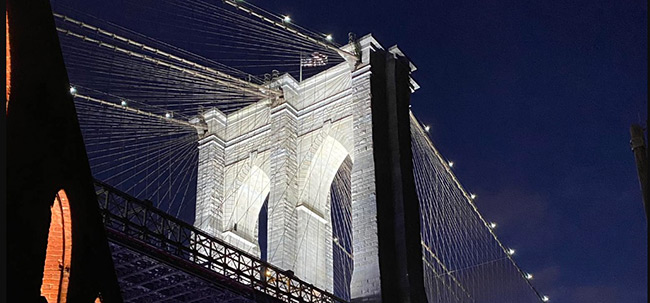
- Two massive granite towers in Gothic Revival style
- Four main suspension cables
- Numerous diagonal stay cables
- A wide deck supporting multiple modes of transport
At the time of its completion, the Brooklyn Bridge was the longest suspension bridge in the world, with a main span of approximately 1,595 feet (486 meters).
The Towers
The bridge’s towers are constructed of limestone, granite, and Rosendale cement. Rising approximately 276 feet above the water, they were the tallest structures in New York City when completed. Their pointed arches give the bridge a cathedral-like appearance, symbolizing strength, permanence, and civic pride.
The Cables
The bridge was the first major structure to use steel-wire cables, rather than iron. This innovation greatly increased tensile strength and durability. Each main cable contains thousands of individual steel wires spun into place using a technique developed specifically for the project.
Construction Challenges
Building the Brooklyn Bridge was an extraordinarily dangerous and complex endeavor. Workers labored in hazardous conditions, particularly within the pressurized caissons beneath the river. Many suffered from decompression sickness, and at least 20 workers are believed to have died during construction.
Political corruption, funding issues, material quality concerns, and public skepticism also plagued the project. At one point, a scandal erupted when a contractor supplied substandard wire, forcing engineers to add additional strands to maintain safety.
Despite these challenges, construction continued for 14 years, from 1869 to 1883, marking one of the most ambitious infrastructure projects of the 19th century.
Opening Day: May 24, 1883
The Brooklyn Bridge officially opened on May 24, 1883, in a grand ceremony attended by President Chester A. Arthur, New York Governor Grover Cleveland, and thousands of citizens. Fireworks, parades, and public celebrations marked the occasion.
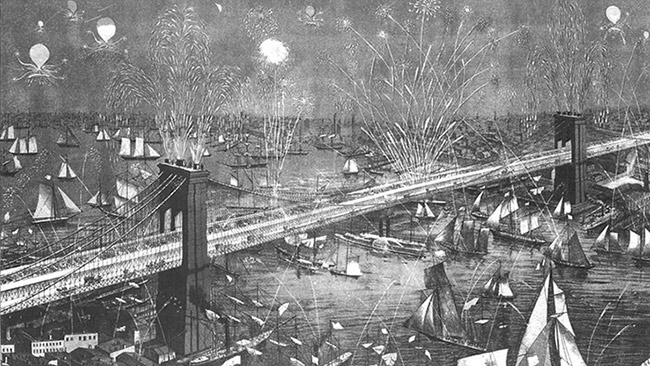
Within 24 hours, more than 150,000 people crossed the bridge on foot. To demonstrate its strength and dispel lingering doubts, circus impresario P. T. Barnum later led a procession of 21 elephants across the bridge, a publicity stunt that successfully reassured the public.
Impact on New York City
The Brooklyn Bridge dramatically transformed New York City. It facilitated the integration of Brooklyn and Manhattan, paving the way for Brooklyn’s eventual consolidation into Greater New York City in 1898.
The bridge boosted commerce, shortened commute times, increased property values, and encouraged urban expansion. It became a physical and symbolic link between communities, contributing to New York’s rise as a global metropolis.
Cultural and Artistic Significance
Beyond its functional role, the Brooklyn Bridge has inspired generations of artists, writers, and filmmakers. It appears prominently in literature, photography, paintings, music, and cinema.
Walt Whitman, Hart Crane, and other literary figures celebrated the bridge as a symbol of modernity and human achievement. In film and popular culture, the bridge often represents New York itself—resilient, dramatic, and iconic.
The Pedestrian Walkway
One of the bridge’s most beloved features is its elevated pedestrian walkway, located above the traffic lanes. This wooden promenade offers panoramic views of Manhattan’s skyline, the Statue of Liberty, and the East River.
Today, the walkway is used by pedestrians and cyclists from around the world, making the bridge not only a transportation structure but also a public space for reflection, recreation, and connection.
Preservation and Renovation
Over its long history, the Brooklyn Bridge has undergone numerous repairs and renovations to address wear, corrosion, and increased traffic demands. Despite these changes, great care has been taken to preserve the bridge’s historic character.
In 1964, the Brooklyn Bridge was designated a National Historic Landmark, ensuring its protection for future generations.
The Brooklyn Bridge Today
More than a century after its completion, the Brooklyn Bridge remains a vital part of New York City’s infrastructure. Each day, it carries tens of thousands of vehicles, pedestrians, and cyclists.
Yet its importance extends far beyond numbers. The bridge continues to stand as a testament to human ingenuity, perseverance, and the belief that bold ideas can reshape cities and lives.
The Brooklyn Bridge is not merely a crossing over water—it is a crossing through time. From the industrial optimism of the 19th century to the global city of the 21st century, the bridge has endured as a powerful symbol of progress and unity.
Its story is one of visionaries and workers, innovation and sacrifice, doubt and triumph. As steel cables stretch between stone towers above the East River, the Brooklyn Bridge reminds us that the greatest structures are built not only with materials, but with courage, imagination, and determination.
Sources
National Park Service (NPS) – Brooklyn Bridge History
Encyclopaedia Britannica, Concise and verified historical and engineering information.
American Society of Civil Engineers (ASCE), Engineering significance and landmark status.
The Brooklyn Museum & New-York Historical Society, Cultural and artistic interpretations of the bridge.
New York City Department of Transportation (NYC DOT), Technical facts, renovations, and structural information.

